|
Zhuo Su Email: suzcpp@gmail.com Google Scholar 中文主页 Dr. Zhuo Su is an associate professor at Beihang University (Beijing University of Aeronautics and Astronautics). He received his Ph.D. in software engineering from Tsinghua University in January 2023 and his bachelor's degree from Northeastern University in June 2018. From 2023 to 2025, Dr. Su conducted postdoctoral research and was selected for the “China National Postdoctoral Program for Innovative Talents” and Tsinghua University’s “Shuimu Scholar Program.” The China Computer Federation (CCF) Technical Committee on Formal Methods recognized him with the “Distinguished Dissertation Award.” Dr. Su was funded by the National Natural Science Foundation of China (NSFC) through its General Program. During his doctoral studies, he received numerous honors, including the Excellent Doctoral Dissertation Award, the Outstanding Graduate Award, the National Scholarship, and the First-Class Scholarship, from Tsinghua University. His research focuses on model-driven software development, particularly automatic code generation and security assurance for embedded control systems. A unified development framework for model-driven software engineering has been proposed, enabling high-speed simulation, efficient high-coverage testing, and high-quality code generation for models and embedded systems built with different tools. The resulting technologies have been applied to aerospace mission software and to Huawei’s vehicle control behavior modeling systems. Related work has been published in flagship conferences and journals, including DAC, ASE, EMSOFT, TSE, and TCAD. |

|
Selected Projects |
|
2026.01 - 2028.12 National Natural Science Foundation of China (NSFC) Major Research Programs - Incubation Projects (sole-PI, 800,000RMB ≈ 110,000USD) 2026.01 - 2027.12 Intelligent Generation of Validation Tests for Control Software from Design Requirements (sole-PI, 200,000RMB ≈ 30,000USD) 2025.12 - 2026.12 Requirements-Driven Validation Test Generation and Sorting for Embedded Software (sole-PI, 300,000RMB ≈ 42,000USD) 2024.01 - 2027.12 National Natural Science Foundation of China (NSFC) General Program (sole-PI, 500,000RMB ≈ 70,000USD) 2023.07 - 2025.03 General Program of China Postdoctoral Science Foundation (sole-PI, 80,000RMB ≈ 11,000USD) 2023.08 - 2024.08 Coverage-Oriented Test Case Generation (Huawei Technologies Co., Ltd., sole-PI, 566,500RMB ≈ 78,000USD) 2024.11 - 2027.11 Trusted Embedded Software Joint Research Center Project (AVIC International Digital Network Technology Co., Ltd., Core participant, 18,000,000RMB ≈ 2,500,000USD) 2019.05 - 2022.06 Trustworthy Embedded Software (Huawei Technologies Co., Ltd., Core participant, 18,750,000RMB ≈ 2,610,000USD) 2018.11 - 2019.12 Information-Physical Systems Convergence Modeling Simulation Methodology (Equipment Research Center, Core participant, 48,000RMB ≈ 66,000USD) |
Research |
|
|
Model-driven development techniques are widely used in safety-critical areas such as aerospace, automotive, and rail transportation. Traditional manual software development methods present significant challenges regarding development efficiency and code security. Using model-based embedded system design effectively reduces the occurrence of software system errors. The model-driven development process consists of four main phases: modeling, simulation, testing, and code generation. |
|
|
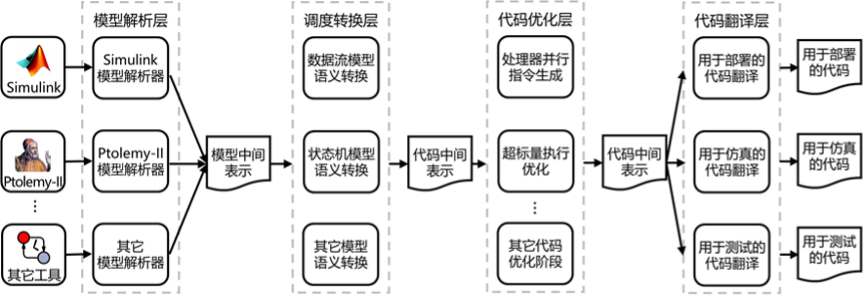
1. Unified Model-Driven Development Framework Based on Intermediate Representation (right figure): The capabilities of modeling tools vary significantly across different domains. Integrating multiple modeling tools within a model-driven design workflow enables us to leverage their complementary strengths. To this end, he proposed a unified code generation framework based on an intermediate representation (IR) that connects diverse modeling tools upstream and supports various types of code generation downstream. Various studies have been conducted based on this framework, including model high-speed simulation, model testing, and high-performance code generation (Papers [1–13]). |
|
|
2. High-Quality Code Generation from Models: The quality of the generated code directly impacts the runtime efficiency of embedded systems. Higher execution efficiency leads to faster system response and smoother task scheduling. To address various limitations of traditional code generators—such as underutilization of vector processors, pipeline stalls, and redundant computations—he developed a series of techniques, including SIMD instruction generation, pipeline scheduling optimization, and redundant code elimination. These techniques enable high-quality code generation for a wide range of models. Across different modeling scenarios, the generated code has achieved 1.2× to 16× efficiency improvements over state-of-the-art (SOTA) methods (Paper [4–5][10–12]). |
|
|
3. Efficient and High-Coverage Model Testing: Model testing is a critical step in model-driven development because it directly affects the safety and stability of the final system. Automated test case generation techniques significantly reduce the manual effort required to construct complex test cases and help users quickly identify design flaws in models. However, traditional approaches, such as constraint-solving-based and random-simulation-based methods, often suffer from slow state space exploration and low feedback efficiency. To overcome these limitations, he proposes state-aware solving, model fuzz testing, and a hybrid method combining both approaches. These techniques are particularly effective for models with complex states and logic. Compared to state-of-the-art methods, the proposed solutions improve test generation efficiency by up to 35x and increase coverage by up to 60% (Paper [6–9]). |
|
|
4. High-Speed Model Simulation: Model simulation is a critical part of the model-driven development process. It directly affects the development cycle and the efficiency of system verification. Traditional simulation approaches based on interpreted execution often perform poorly, rendering them ineffective for validating large-scale simulation data. To address this issue, he proposed a simulation acceleration method that leverages code generated from models. This method integrates instrumentation code to collect comprehensive simulation data, including anomaly diagnosis, trace logging, and coverage analysis. Additionally, a simulation state-aware input-skipping technique was developed to accelerate the simulation process further. These techniques have led to a remarkable 215.3× improvement in simulation efficiency compared to state-of-the-art methods (Paper [13–14]). |
|
|
5. Requirements-Driven Intelligent System Testing: Validation testing is a critical step in ensuring the functional correctness, safety, and reliable operation of control software, and directly determines whether design requirements can be thoroughly and accurately verified. Traditional validation testing relies heavily on test engineers to manually develop test scripts, resulting in long development cycles and a strong dependence on expert knowledge and experience. To address the characteristics of control software requirements, including intensive domain knowledge, numerous interface parameters, and stringent timing constraints, we investigate intelligent validation test generation methods that integrate large language models with multi-source engineering knowledge, and establish an intelligent validation testing workflow spanning design requirement understanding, test scenario construction, test script and test oracle generation, and execution-feedback-driven refinement. |
|
|
6. Industrial Deployment: He developed a comprehensive model-driven development (MBD) toolset centered around a unified, intermediate-representation-based code generation framework. The toolset supports the parsing of Simulink and Ptolemy models, as well as dynamic dataflow and dataflow model scheduling transformations. It also includes multiple code optimization modules and various code translators for model simulation, testing, verification, and deployment. These components incorporate all of Dr. Su’s advanced research techniques. The toolset comprises more than 200,000 lines of code and has been integrated into Huawei’s code repository. It has also been incorporated into Huawei’s in-house behavioral modeling tool, with the resulting technologies successfully deployed in the automotive and aerospace sectors. |
|
Publications |
|